
“The Mind: Your Greatest Friend or Worst Enemy – Timeless Wisdom from the Bhagavad Gita”
Discover how the Bhagavad Gita teaches that the mind can be your greatest ally or your worst enemy—and how to master it for personal growth.
The Mind: Your Greatest Friend or Worst Enemy – Timeless Wisdom from the Bhagavad Gita
Introduction
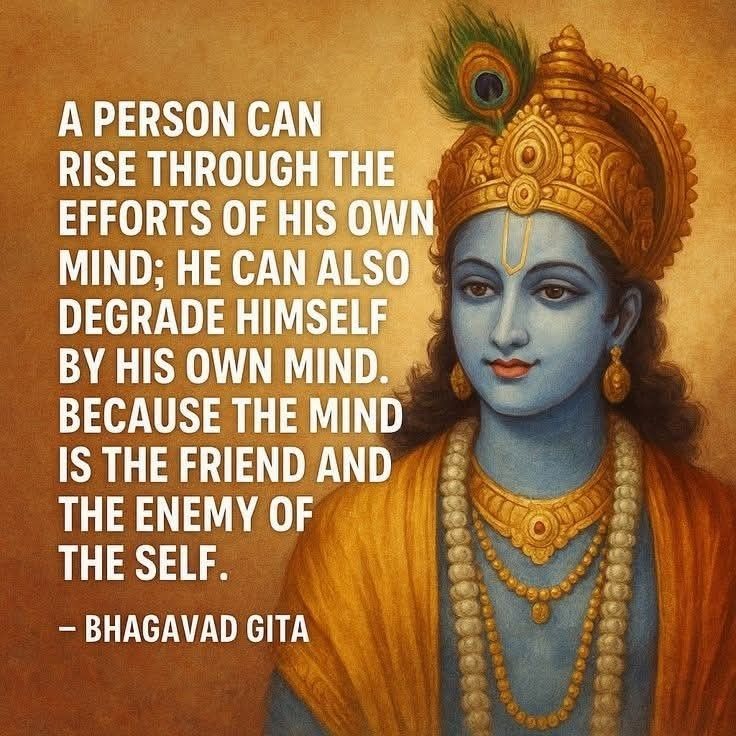
“A person can rise through the efforts of his own mind; he can also degrade himself by his own mind. Because the mind is the friend and the enemy of the self.” — Bhagavad Gita
This powerful teaching from the Bhagavad Gita (Chapter 6, Verse 5) reminds us that our greatest strength and our greatest obstacle both reside within us — the mind.
In a world filled with distractions, stress, and self-doubt, this ancient wisdom is more relevant than ever. Let’s explore how mastering the mind can transform our lives.
Understanding the True Meaning of the Verse
In this verse, Lord Krishna advises Arjuna that self-elevation and self-destruction both come from within. The external world does not control our destiny — our thoughts do.
The Sanskrit verse states:
Uddhared ātmanātmānaṁ nātmānam avasādayet
Ātmaiva hyātmano bandhur ātmaiva ripur ātmanaḥ.
It teaches:
Self-discipline leads to growth.
Lack of mental control leads to downfall.
The mind is neutral — it becomes what we train it to be.
How the Mind Becomes Your Friend
When disciplined and directed properly, the mind becomes:
1. A Source of Strength
Positive thinking builds resilience and confidence.
2. A Guide Toward Purpose
Clarity of thought helps align actions with goals.
3. A Tool for Inner Peace
Meditation, reflection, and mindfulness calm mental chaos.
Practices such as yoga, meditation, journaling, and gratitude cultivate a supportive inner voice.
How the Mind Becomes Your Enemy
An uncontrolled mind can lead to:
Negative self-talk
Fear and anxiety
Procrastination
Anger and impulsiveness
Self-sabotage
When we allow negative patterns to dominate, we become prisoners of our own thoughts.
Practical Steps to Master Your Mind
Here are actionable ways to apply the Gita’s wisdom:
✅ Practice Daily Mindfulness
Spend 10–15 minutes observing your thoughts without judgment.
✅ Replace Negative Thoughts
Challenge limiting beliefs and consciously reframe them.
✅ Develop Self-Discipline
Small consistent habits build mental strength.
✅ Control Inputs
Limit exposure to negativity — news, toxic conversations, and distractions.
✅ Read Spiritual or Inspirational Texts
Regular study of wisdom literature strengthens clarity and perspective.
Why This Teaching Is Relevant Today
Modern psychology echoes what the Bhagavad Gita taught thousands of years ago — our thoughts shape our reality. Cognitive Behavioral Therapy (CBT), positive psychology, and neuroscience all confirm the power of mindset.
The Gita’s message is simple yet profound:
You are not a victim of circumstances. You are a product of your thoughts.
Final Reflection
The battlefield described in the Bhagavad Gita symbolizes the inner battle within each of us. Every day, we choose whether our mind will uplift us or pull us down.
Master your mind, and you master your life.